

BrandlyUp website system
The BrandlyUp website demonstrates editorial art direction and structured content — the pattern a collection launch needs to present craft and detail without vague claims.
Inspect the internal work recordVisual identity, collection storytelling and shopping communication for fashion labels and apparel businesses.
Takes 2 minutes · No signup to start · Get a free downloadable PDF report

Label marketing should not start with “how many posts?”
It should start with what people need to understand — and what your teams need to manage.
The BrandlyUp website demonstrates editorial art direction and structured content — the pattern a collection launch needs to present craft and detail without vague claims.
Inspect the internal work recordLabels match the work page: the internal record shows our own delivered website; concepts are independent fictional scenarios, not client projects. Commissioned client evidence appears here only with permission.
These are common situations to assess, not assumptions about every label. BrandlyUp can improve communication systems; operational and clinical decisions stay with your team.
Strong design needs a coherent story and visual direction.
Sizing, materials and garment care affect buying confidence.
Unconnected creative makes it harder to recognise your label.
Three connected disciplines — branding, marketing and reputation — shaped around your label, not around a posting calendar.

Define the label story, art direction and collection language.
Shoppers can recognise your aesthetic across launches.

Create fit, fabric and styling content around each collection.
Customers can picture the garment in their own wardrobe.

Set honest product-description standards and care and returns guidance.
Buyers can judge materials, fit guidance and aftercare before choosing.
Instead of vague claims, here is a representative structure for a label engagement — illustrative and proposed for your brief, not a client result or a live account.
| Work area | What you receive | How it is measured |
|---|---|---|
| Give the collection a point of view |
| Sell-through |
| Help customers understand the garment |
| Fit-related returns |
| Connect the brand experience |
| Repeat customers |
A proposed measurement plan. Targets follow your baseline and the data you can provide.
Units sold as a share of the agreed available collection.
PercentageReturns classified with agreed fit-related reasons.
PercentageCustomers buying again within the chosen period.
PercentageA sample planning scope for this sector, with the inputs and approvals a project needs.
Phases and timings are sample planning scopes, not committed schedules. The agreed plan, review cadence and fees follow discovery.
Compare engagement modelsEvery engagement includes a shared workspace for deliverables, approvals and reporting — plus free self-checks you can use right now, before you talk to anyone.
Keep collection stories, fit and care content and campaign assets together in one shared workspace, with review status visible across every launch.
Review audience, offer and differentiation.
No account needed · FreeOpen in ToolsReview evidence, policies and accountability.
No account needed · FreeOpen in ToolsMatch your industry and challenge to a relevant scope.
No account needed · FreeStart on this pageThe dashboard is included with your engagement — it is not sold as standalone software. Previews show a representative sample, not your live data. Self-checks are free, need no account and do not scan your website or assign a score.
Six practical questions about your current communication. Questions for your selected challenge appear first. Answer from what you know; “Not sure” is a useful answer. This does not scan your website.
1. Can a new visitor tell what your label stands for within one screen?
2. Does each collection have a story beyond the individual garments?
3. Do product pages explain fit, fabric and care in comparable detail?
4. Are size guidance and measurements consistent across every product?
5. Are material and sustainability claims backed by evidence you can show?
6. Do your channels feel like one label rather than several?
Collection story · Campaign art direction · Lookbook structure
Fit-content framework · Product descriptions · Garment-care copy
Visual guidelines · Social templates · Retail communication
DRAFT PROJECT BRIEF — human review required
Industry: Fashion & Apparel
Business type: Independent labels
Website: Not sure / not provided
Assessment: Not completed (industry-readiness-v2; self-assessment, not a website audit)
Inputs: current materials, business goals, audience questions and approved evidence.
Exclusions: advertising/media costs, third-party subscriptions, guarantees and regulated advice.
Measurement: Sell-through; Fit-related returns; Repeat customers. Baselines agreed at review.
Approvals: client sign-off for facts, claims, creative and launch. Pricing pending review.
Your priorities: To discuss
Next: review scope with BrandlyUp; agree responsibilities, timing and price before work starts.
Inputs, exclusions, approvals and measurement are included in the draft. Review it above any time — nothing is sent. Answers and notes stay in this page’s memory only; chosen service IDs are kept in this tab for up to 24 hours so you can return to your plan.
Share your name and email — we’ll send a formatted PDF copy of this brief and follow up on next steps.
A working concept for how branding, marketing and reputation could look — not a finished design, a live client project or a claim about results.
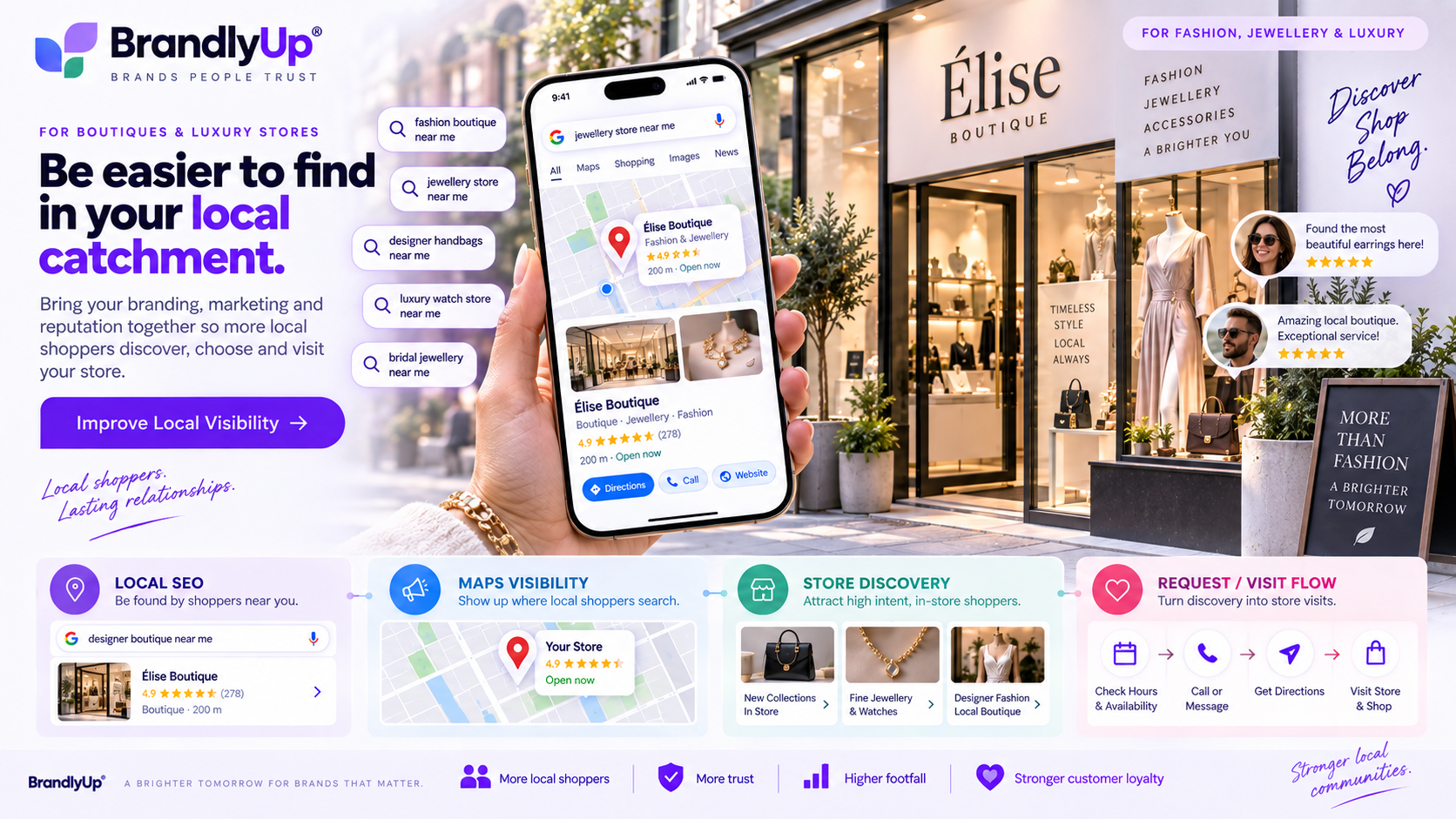
Show the label's point of view while reducing uncertainty about fit and quality.
Label identity, collection narrative and visual direction.
Collection launches, styled product content and shopper journeys.
Useful size/fit guidance, material details and genuine customer feedback.
Sell-through · Fit-related returns · Repeat customers
Proposed scope, tailored after discovery. Outcomes depend on your starting point and execution.Foundation packages are one-time implementation projects. Monthly packages are ongoing alternatives — not cumulative purchases on top of a foundation. Final fees follow an agreed scope after discovery.
One-time implementation: identity, information and enquiry handling organised.
Request a scoped quote
A consistent identity and organised information foundation.
Taxes, advertising spend, hosting, third-party subscriptions, onsite production, printing and major integrations are quoted separately.
Ongoing communication, information accuracy and review governance.
Request a scoped quote
Current information and consistent communication.
Taxes, advertising spend, hosting, third-party subscriptions, onsite production, printing and major integrations are quoted separately.
Central governance for multi-location or multi-audience operations.
Request a scoped quote
Consistent communication with clear ownership of ongoing work.
Taxes, advertising spend, hosting, third-party subscriptions, onsite production, printing and major integrations are quoted separately.
Fashion Foundation sets up identity, information and enquiry handling once. Fashion Visibility & Communication and Fashion Communication Partner keep that work current — choose one ongoing level, not both. If your website and materials already work, start from the maintenance level rather than a rebuild. Not sure which level fits? Compare engagement models.
Package scope examples for this industry. Draft pricing is pending internal approval and is not shown publicly.
A working site with its own identity, pages, enquiry journey and Hindi edition. Use it to judge the direction before we tailor one to your business.
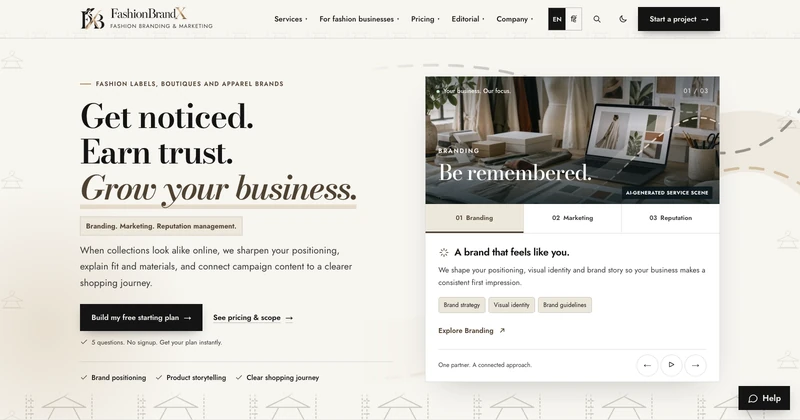
Brand direction, collection campaigns and reputation for fashion businesses.
Start with one priority, or combine disciplines in an agreed scope. These are example deliverables, not a package that every business needs.
Discuss your business, priority and available materials. If the work is a fit, agree scope, deliverables, review responsibilities, fees and timing before starting. No fixed turnaround or free audit is implied.
Compare engagement options.
Your current website and brand assets, approved information about your offer, the audience you want to reach, one decision owner and suitable reviewers. Material, sustainability and performance claims require supporting evidence. Photography and production are separately scoped.
The focus is brand, marketing and reputation communication. Booking engines, payments, CRM replacement and operating software are separate technical projects. Any integration work must be scoped explicitly.
No. We can define the work, improve communication and agree a measurement plan. Sales also depend on your offer, pricing, demand, traffic quality and follow-up. Baselines and targets are agreed using your available data.
The industry photographs show representative businesses, people and working environments. They are stock photography, not BrandlyUp client projects or endorsements. Our proposed scope is tailored to your brief; the work page identifies actual work and concepts.
Fees are proposed after a short discovery, because scope varies with locations, products or services, languages, channels and approval complexity. The pricing page explains the engagement models and what is included; we do not quote invented starting prices here.
Yes. The engagement is scoped around named deliverables and review owners, so your agency or team can keep the channels they run. At discovery we agree who produces, who reviews and who publishes, to avoid duplicated work.
Approved lookbook imagery, tech-pack fit data and the season calendar. We structure the collection story, fit and care content and launch campaign assets around them; photography production is separately scoped.
Choose your priority and tell us what needs to change. Your fashion & apparel brief stays right here.
Material, sustainability and performance claims require supporting evidence. Photography and production are separately scoped.
Deliverables and targets are agreed in discovery. These are proposed approaches and illustrative images, not achieved client results. Booking, CRM and other integrations need a separately agreed technical scope.


